# Templates
Templates are reusable building blocks for the experiences you deploy to your readers. Design a component once — with its own HTML, JavaScript, and CSS — then use it across as many [Interactions](/product/interactions.md) as you need.
## Overview[](#overview "Direct link to Overview")
Think of a template as a self-contained widget. It holds everything the browser needs to render a component: markup for structure, styles for presentation, and scripts for behavior. On top of that, you can define **fields** — named placeholders that each Interaction fills in with its own values — so one template can power many different experiences.
Templates also support **external CSS URLs** for loading fonts, icon libraries, or CSS frameworks alongside your code.
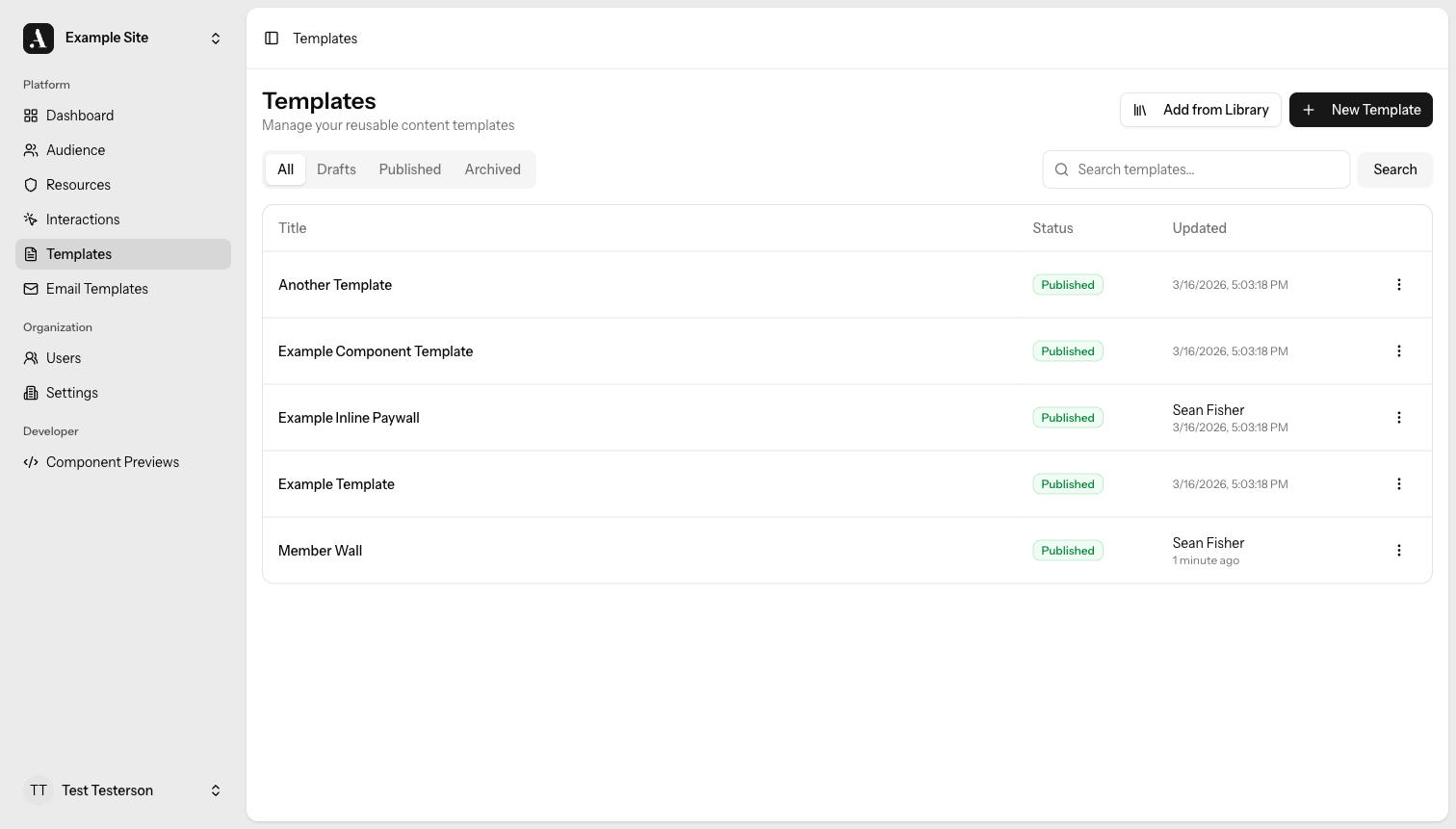
## Creating a Template[](#creating-a-template "Direct link to Creating a Template")
Head to **Templates → New Template**, give it a title, and start writing your HTML, CSS, and JavaScript. A URL-friendly slug is generated from the title on first save. Renaming the template later won't change the slug, so any Interactions that reference it stay linked.
## Status[](#status "Direct link to Status")
Every template starts as a **Draft** so you can iterate without affecting live Interactions. When you're ready, publish it.
| Status | Meaning |
| ------------- | -------------------------------------------------------- |
| **Draft** | Work in progress — not available for use in Interactions |
| **Published** | Ready to use |
## Fields[](#fields "Direct link to Fields")
Fields make templates flexible. Instead of hard-coding copy or settings, you define named variables that each Interaction supplies at render time.
For example, a "Subscribe Banner" template might expose a `headline` field. One Interaction sets it to "Join our newsletter", another to "Get daily updates" — same template, different message.
Each field has four properties:
| Property | Description |
| --------------- | ---------------------------------------------------------------------------------------------------------- |
| **Name** | A human-readable label (e.g. "Email Placeholder") |
| **Slug** | The variable name used in your code (e.g. `emailPlaceholder`). Auto-generated from the name if left blank. |
| **Description** | Help text shown to whoever configures the Interaction |
| **Type** | `text`, `number`, or `checkbox` |
### Using Fields in Your Code[](#using-fields-in-your-code "Direct link to Using Fields in Your Code")
Reference a field by wrapping its slug in `{% %}` anywhere in the HTML:
```html
{% headline %}
```
## External CSS URLs[](#external-css-urls "Direct link to External CSS URLs")
Need Google Fonts, a CSS reset, or a utility framework? Add the stylesheet URLs to the template and they'll be injected as `` tags at render time — no manual `` editing required.
## Revision History[](#revision-history "Direct link to Revision History")
Every save creates a new revision automatically. You can browse the full history, compare any two versions side by side, and roll back whenever you need to. See [Revisions](/product/interactions/revisions.md) for details.
## Archiving[](#archiving "Direct link to Archiving")
Templates are never permanently deleted right away. Instead, you **archive** them:
* Archived templates disappear from normal listings.
* Members and admins can restore an archived template at any time.
* Only admins can permanently delete one.
To archive, open the template and choose **Archive** from the actions menu. To restore, switch to the **Archived** filter in the Templates list.
## Permissions[](#permissions "Direct link to Permissions")
For details on who can manage templates, see [Permissions](/product/administration/permissions.md).
## How Templates Render[](#how-templates-render "Direct link to How Templates Render")
When an Interaction triggers, Allegro injects the template into the page at the configured position. Each template runs in its own isolated environment, so its styles won't affect the rest of the page and the page's styles won't bleed in.
Templates support **Alpine.js** for reactive behavior and Allegro's **web components** (login form, email capture, content gate) out of the box — no extra setup required.
For technical details on the rendering model, available JavaScript context, and Alpine.js data, see the [Templates guide](/developer/guides/templates.md) in the developer docs.
## Tips[](#tips "Direct link to Tips")
* **Keep CSP in mind.** Template HTML, CSS, and JavaScript run in the reader's browser. If your site enforces a strict Content Security Policy, make sure inline scripts and styles are allowed.
## Related[](#related "Direct link to Related")
* [Interactions](/product/interactions.md) — Deploy templates to your readers
* [Revisions](/product/interactions/revisions.md) — Full version history and rollback